
State Regulation
US State E-Waste Laws: Landfill Bans and Producer Responsibility by State
Most electronic-waste regulation in the United States happens at the state level, where 25 states plus the District of Columbia operate recycling laws and landfill disposal bans. The rules vary by state in their model, covered devices, and obligations. All Green Recycling processes electronics at a facility aligned to ISO 14001:2015 environmental management practices and supports businesses managing end-of-life equipment across multiple state programs.
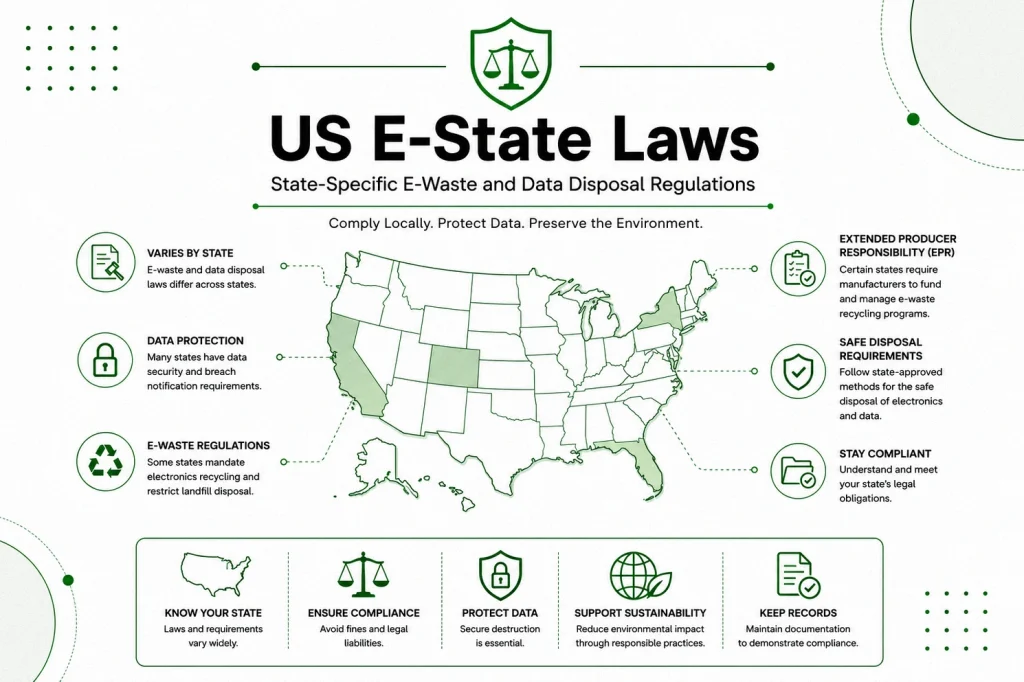
What Are US State E-Waste Laws?
United States electronic-waste regulation is primarily a state matter. There is no single federal recycling mandate for consumer and business electronics, so 25 states plus the District of Columbia have enacted their own laws that govern how covered electronic devices are collected, recycled, and kept out of landfills.
Publisher: Individual state legislatures and environmental agencies
Key models: Extended Producer Responsibility (most states); the Advanced Recycling Fee model (California); landfill disposal bans (many states)
Legal force: Mandatory within each enacting state. Obligations differ by state, so multi-state operations face a patchwork.
The laws share a common goal: divert electronics containing lead, mercury, and other hazardous constituents away from landfills and into responsible recycling. They differ in who pays, which devices are covered, and what businesses and manufacturers must do. A national organization must therefore map its disposal practices to each state where it operates.
What Do State E-Waste Laws Require?
State e-waste laws require some combination of manufacturer-funded collection, recycling of covered devices, registration and reporting by producers, and prohibition of landfill disposal for covered electronics. The specific obligations depend on the state’s regulatory model.
Extended Producer Responsibility (EPR)
Most state programs use an EPR model in which manufacturers fund and organize the collection and recycling of covered devices. Producers register with the state, meet recycling targets, and report annually. States using this model include New York, Illinois, Washington, Minnesota, and many others.
The Advanced Recycling Fee model (California)
California funds recycling through a consumer fee collected at the point of sale, rather than direct manufacturer financing. The California Electronic Waste Recycling Act is the leading example of this model.
Landfill disposal bans
Many states prohibit disposing of covered electronics, and often batteries and other universal waste, in municipal landfills. A business in a ban state cannot simply throw equipment in the trash; it must route covered devices to a recycler.
Covered-device definitions
States define covered devices differently. Some cover only consumer products such as televisions, monitors, and computers, while others extend to a broader list. A device regulated in one state may be unregulated in another, which complicates multi-state disposal.
Registration and reporting obligations
Under producer-responsibility programs, manufacturers that sell covered devices into a state generally must register with the state agency, fund or arrange recycling, and file periodic reports showing the weight of material collected against targets. Some states also require retailers to sell only the brands of registered manufacturers, which turns registration into a condition of market access. These administrative obligations sit alongside the physical recycling requirement, and missing a registration or report can carry its own penalty even when devices are being recycled properly. Organizations that both sell and dispose of electronics may therefore carry obligations on both sides of the program.
Consumer and business collection channels
State programs typically establish collection channels so covered devices can be returned without charge or at low cost, through manufacturer takeback, municipal events, and registered recyclers. Business-generated electronics are sometimes handled differently from household devices, with separate arrangements for volume generators. A business managing a fleet of retired equipment usually works directly with a recycler rather than through consumer drop-off points, which is why a recycler that documents each pickup helps the business show its covered devices entered an approved channel rather than a landfill.
How All Green Recycling Supports Multi-State Compliance
All Green Recycling processes electronics at a facility aligned to ISO 14001:2015 environmental management practices and helps organizations manage end-of-life equipment consistently across varying state programs. Applying responsible recycling to all covered devices, regardless of the strictest applicable state rule, simplifies multi-state compliance.
| State-law need | All Green Recycling control |
|---|---|
| Avoid landfill disposal of covered devices | Zero-landfill Electronics Recycling |
| Recycle consumer and business equipment | Computer Recycling and IT Asset Disposition |
| Document responsible recycling | Certificate of Recycling per pickup |
| Consistent practice across states | ISO 14001:2015 environmental management practices |
All Green Recycling’s recycling is run to ISO 14001:2015 environmental management practices, and the company demonstrates responsible handling through documented process rather than third-party certification claims. The state e-waste laws themselves are regulations that businesses and manufacturers comply with, not certifications. All Green Recycling supports a client’s compliance by recycling covered devices responsibly and issuing a Certificate of Recycling that documents lawful diversion from landfill.
For an organization spanning several states, the documentation is what makes a single recycling practice auditable. A Certificate of Recycling per pickup gives the organization a uniform record regardless of which state the equipment came from, so it can demonstrate to any state agency or customer that its covered devices entered responsible recycling. Paired with the ISO 14001:2015 environmental management practices that govern the processing, this gives a multi-state operator both a consistent practice and the evidence to support it across every jurisdiction in which it disposes of electronics.
Who Must Comply With State E-Waste Laws?
State e-waste laws reach manufacturers, retailers, and the businesses and institutions that generate end-of-life electronics within a regulated state. Manufacturers face registration, financing, and reporting obligations. Generators face landfill-disposal prohibitions and a duty to route covered devices to recycling.
A retail chain selling covered devices in multiple states may carry registration and takeback obligations in each. A multi-state enterprise disposing of equipment must observe each state’s landfill ban and covered-device list. Even organizations without manufacturer obligations must avoid prohibited landfill disposal, which makes a responsible recycler essential for compliant end-of-life management.
The practical difficulty for a multi-state operator is the patchwork itself. A device that is a covered electronic device subject to a landfill ban in one state may be unregulated in a neighboring one, and the financing model, reporting cadence, and covered-device list differ across the 25 states and the District of Columbia that run programs. Maintaining a different disposal rule for each jurisdiction is error-prone. The simpler and more defensible approach is to apply the strictest applicable standard everywhere: route all covered electronics to documented, responsible recycling regardless of the state, so that no shipment violates a local ban and every disposal is supported by a recycling record.
Enforcement and Consequences
State environmental agencies enforce e-waste laws through registration audits, inspections, and penalties. Because the rules are state-specific, the enforcement mechanism and penalty amounts vary.
Manufacturer penalties: Producers that fail to register, meet recycling targets, or report can face state fines, sales prohibitions, and removal from approved-product lists.
Disposal-ban penalties: Businesses that send covered electronics to landfill in a ban state can face civil penalties assessed by the state environmental agency.
Reputational and contractual exposure: Improper disposal that surfaces publicly, or that violates a customer’s environmental requirements, can cost contracts and damage standing, beyond the direct state penalty.
Frequently Asked Questions
Is there a federal e-waste recycling law in the United States?
There is no single federal law mandating the recycling of consumer and business electronics. Federal regulation reaches electronics through the hazardous-waste rules of RCRA, but the recycling mandates themselves are state laws. As of 2025, 25 states plus the District of Columbia operate electronic-waste programs, so compliance is determined state by state rather than by a national recycling statute.
Are state e-waste laws mandatory or voluntary?
State e-waste laws are mandatory within each enacting state. They impose binding obligations: manufacturers must register and fund recycling under producer-responsibility models, and businesses must avoid landfill disposal of covered devices where bans apply. State environmental agencies enforce the laws with fines, sales prohibitions, and other penalties. A multi-state organization must comply with each applicable state program, which differ in model, covered devices, and obligations.
How does All Green Recycling help with multi-state e-waste compliance?
All Green Recycling processes electronics at a facility aligned to ISO 14001:2015 environmental management practices and applies responsible recycling to all covered devices, which lets an organization maintain a consistent practice across varying state rules. The company recycles consumer and business equipment with zero landfill, manages hazardous constituents under the applicable standards, and issues a Certificate of Recycling per pickup. That documentation evidences lawful diversion from landfill in any ban state.
What is Extended Producer Responsibility in e-waste laws?
Extended Producer Responsibility (EPR) is the model most states use, under which manufacturers fund and organize the collection and recycling of the covered devices they sell. Producers register with the state, meet recycling targets, and report annually. California is the notable exception, funding recycling through an Advanced Recycling Fee collected from consumers at the point of sale rather than through direct manufacturer financing.
Which states ban electronics from landfills?
Many of the states with e-waste programs prohibit disposing of covered electronics in municipal landfills, and several extend the ban to batteries and other universal waste. The specific covered-device lists and ban scopes vary by state. Because the prohibitions differ, a business operating in multiple states benefits from routing all covered electronics to responsible recycling, which satisfies the strictest applicable rule and avoids inadvertent violations.
Why apply the strictest state standard across all locations?
Applying the strictest applicable standard everywhere is a risk-management choice that simplifies compliance for an organization operating in several states. Because covered-device lists and landfill bans vary, tracking a separate rule for each location invites mistakes, especially when equipment is consolidated and shipped from a central point. Treating all covered electronics as if they were subject to the most stringent state ban means no individual shipment can fall foul of a local prohibition, and a single recycling process produces uniform documentation. All Green Recycling supports this by recycling all covered devices with zero landfill and issuing a Certificate of Recycling per pickup, giving the organization consistent evidence across every state in which it operates.
How do state e-waste laws interact with data destruction?
Recycling a covered device does not by itself protect the data stored on it, so end-of-life electronics that contain storage media require both compliant recycling and data destruction. All Green Recycling combines responsible recycling under state e-waste laws with Data Destruction services such as Hard Drive Shredding, so a single end-of-life process satisfies both the environmental recycling mandate and the applicable data-disposal obligations.
How does a business know which states’ e-waste laws apply to it?
A business is generally subject to a state’s e-waste law where it places covered devices on that state’s market as a manufacturer or retailer, or where it generates and disposes of covered electronics within that state. A multi-state operator therefore has to map both its sales footprint, which drives producer and takeback duties, and its disposal locations, which drive landfill-ban obligations. Because the 25 states and the District of Columbia with programs define covered devices and bans differently, the most reliable approach is to apply responsible, documented recycling everywhere rather than to track each rule device by device. All Green Recycling supports this with consistent processing and a Certificate of Recycling per pickup that works as evidence in any jurisdiction.
Need compliant destruction services that satisfy US State E-Waste Laws?
Bonded · Insured · Certificate of Destruction · Methods follow US State E-Waste Laws