
Federal Regulation
Universal Waste Rule: Batteries, Lamps, and Mercury Devices at 40 CFR Part 273
The Universal Waste Rule at 40 CFR Part 273 streamlines the federal hazardous-waste requirements for widely generated wastes such as batteries, lamps, and mercury-containing devices, to encourage their collection and recycling. All Green Recycling handles these universal wastes and processes them at a facility aligned to ISO 14001:2015 environmental management practices, keeping mercury, lead, and cadmium out of landfills.
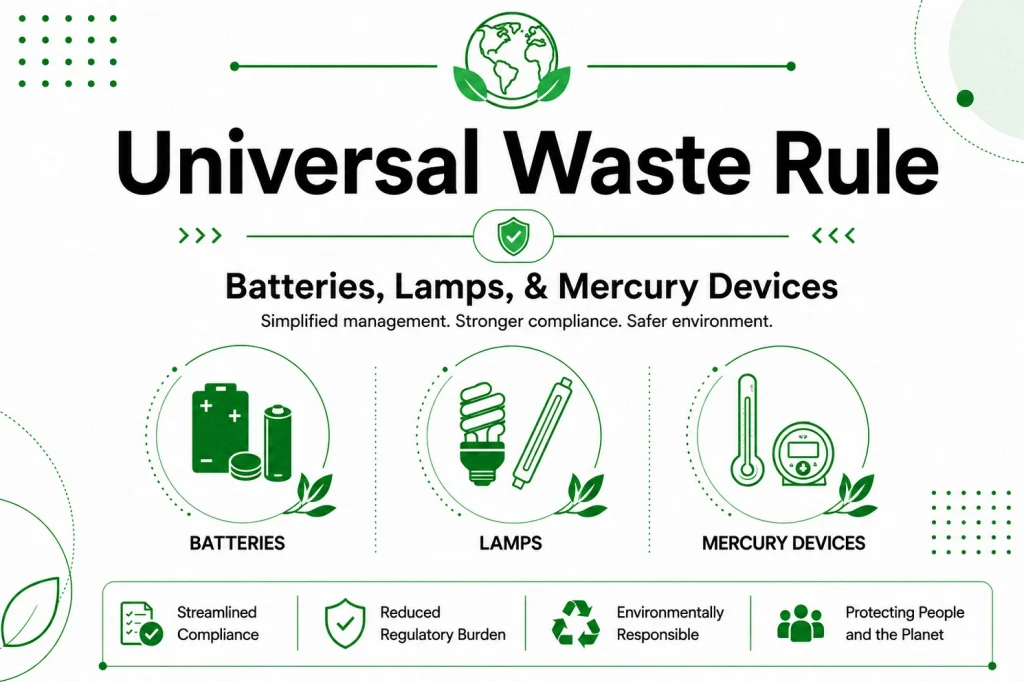
What is the Unverisal Waste Rule?
The Universal Waste Rule, codified at 40 CFR Part 273, is a streamlined set of federal hazardous-waste management standards for certain widely generated wastes. The U.S. Environmental Protection Agency created it under RCRA to ease the regulatory burden on common hazardous items, encouraging proper collection and recycling rather than improper disposal.
Publisher: U.S. Environmental Protection Agency (EPA)
Federal universal wastes: batteries, pesticides, mercury-containing equipment (such as thermostats), lamps, and aerosol cans (added in 2019)
Legal force: Mandatory federal regulation. States may add categories; California, for example, regulates electronic devices and CRTs as universal waste.
The rule recognizes that batteries, fluorescent lamps, and mercury devices are generated by a huge range of businesses in small quantities. Rather than subject every office and facility to full hazardous-waste generator requirements for a box of dead batteries, the Universal Waste Rule provides simplified handling, storage, and transport standards that still ensure the material reaches a proper destination facility.
What Does the Universal Waste Rule Require?
The Universal Waste Rule requires handlers to manage universal waste to prevent releases, label and date containers, limit accumulation to one year, train staff, and send the material to a designated destination facility for recycling or proper treatment.
Handler categories
The rule defines small quantity handlers, who accumulate less than 5,000 kilograms of total universal waste at one time, and large quantity handlers, who accumulate 5,000 kilograms or more. Large quantity handlers carry additional notification and recordkeeping duties.
Container management and labeling
Universal waste must be managed in closed, structurally sound containers that prevent releases, and each container or area must be labeled to identify the waste, for example “Universal Waste Batteries” or “Universal Waste Lamps.”
One-year accumulation limit
A handler may accumulate universal waste for no longer than one year, and must be able to demonstrate the length of accumulation, for example with a label showing the date the period began. The limit prevents indefinite storage of hazardous material.
Transport to a destination facility
Universal waste does not require a hazardous-waste manifest for shipment, which is part of the streamlining, but it must be sent to a destination facility that recycles, treats, or disposes of it under full hazardous-waste standards. Handlers must not dispose of universal waste in the trash.
Lithium batteries and release prevention
The release-prevention duty has taken on added weight as lithium-ion batteries have proliferated in laptops, phones, and backup units. Damaged, defective, or improperly stored lithium cells can short and ignite, and battery fires at collection points and processing facilities are a recognized hazard. Managing batteries as universal waste therefore involves not only keeping them out of landfill but storing and handling them so that terminals are protected and damaged cells are isolated. A handler that lets spent batteries accumulate loosely in a bin is creating both a regulatory and a safety problem, which is one reason scheduled removal to a proper recycler matters.
Employee training and response
Universal-waste handlers must ensure that employees who manage the material know how to handle it and how to respond to releases, with the depth of training scaling by handler category. Large quantity handlers carry more formal training and recordkeeping duties, while small quantity handlers must still inform staff of proper handling and emergency procedures. This requirement reflects that universal waste, though streamlined, remains hazardous: a broken fluorescent lamp releases mercury vapor, and a damaged battery can ignite, so the people handling these items need to know the basic precautions and the steps to take if a container is breached.
How All Green Recycling Handles Universal Waste
All Green Recycling acts as a handler and recycling channel for universal wastes such as batteries, lamps, and mercury-containing devices, and processes them at a facility aligned to ISO 14001:2015 environmental management practices. The company’s environmental management system is aligned to ISO 14001:2015.
| Universal waste need | All Green Recycling control |
|---|---|
| Collect batteries from end-of-life equipment | Battery removal during Electronics Recycling |
| Manage lamps and mercury devices | Selective handling and managed downstream treatment |
| Keep universal waste out of landfill | Zero-landfill recovery and recycling |
| Document responsible handling | Certificate of Recycling per pickup |
All Green Recycling’s recycling is run to ISO 14001:2015 environmental management practices, and the company demonstrates responsible handling through documented process rather than third-party certification claims. The Universal Waste Rule is a federal regulation that handlers comply with, not a certification. All Green Recycling supports a client’s compliance by collecting and recycling universal wastes through proper channels and documenting it with a Certificate of Recycling.
The practical value to a handler is twofold. First, scheduled pickups keep batteries and lamps moving to a proper destination facility within the one-year accumulation window, which is the most common way handlers fall out of compliance. Second, the per-pickup Certificate of Recycling gives the handler a dated record that the material was routed to recycling rather than placed in the trash, which is precisely the evidence that demonstrates the streamlined universal-waste status was maintained. For an organization that also retires electronics, integrating universal-waste collection into the same process means the batteries and lamps inside that equipment are captured and documented alongside the devices themselves.
Who Must Comply With the Universal Waste Rule?
The Universal Waste Rule applies to any business that generates, collects, or handles the covered wastes, which is nearly every organization, because batteries and lamps are ubiquitous. The rule’s handler categories scale the requirements by the quantity accumulated.
A property management company replacing fluorescent lamps across a portfolio, a manufacturer generating spent batteries, and a healthcare facility retiring mercury-containing equipment are all universal-waste handlers. Each must manage the material under Part 273, avoid trash disposal, and route it to a recycler or destination facility. Organizations that retire electronics also generate universal waste in the form of the batteries and lamps inside that equipment.
The near-universal reach of the rule is what makes it easy to overlook. Almost every organization generates spent batteries and used lamps as a matter of routine operations, well before it ever considers itself a hazardous-waste handler. An office swapping out uninterruptible-power-supply batteries, a school replacing lighting, and a warehouse cycling through forklift and scanner batteries are all accumulating universal waste that cannot lawfully go in the trash. Because the obligation attaches to such ordinary activity, the practical compliance question for most organizations is simply whether they have a reliable channel to collect these items and a record showing they were recycled rather than discarded.
Enforcement and Consequences
The EPA and authorized state agencies enforce the Universal Waste Rule under RCRA authority. Mismanagement can cause the waste to lose its universal-waste status and revert to full hazardous-waste regulation, with corresponding penalties.
Loss of streamlined status: A handler that violates Part 273, for example by disposing of universal waste in the trash or exceeding the one-year limit, can be treated as a generator of fully regulated hazardous waste, triggering the stricter Subtitle C requirements and penalties.
RCRA penalties: Because the rule sits under RCRA, violations can draw the same civil penalties, which are adjusted for inflation and exceed $80,000 per violation per day at the statutory maximum.
State enforcement: Authorized states enforce their own universal-waste programs, some broader than the federal rule, with additional categories and penalties.
Frequently Asked Questions
What wastes are covered by the federal Universal Waste Rule?
The federal Universal Waste Rule at 40 CFR Part 273 covers five categories: batteries, pesticides, mercury-containing equipment such as thermostats, lamps including fluorescent and other mercury-containing bulbs, and aerosol cans, which were added in 2019. States may regulate additional categories as universal waste. California, for example, treats electronic devices and cathode-ray tubes as universal waste, which broadens what handlers in that state must manage under the streamlined standards.
Is the Universal Waste Rule mandatory or voluntary?
The Universal Waste Rule is a mandatory federal regulation under RCRA, though it is a streamlined alternative to full hazardous-waste generator requirements. Handlers must manage covered wastes under Part 273: label and date containers, limit accumulation to one year, prevent releases, and send material to a proper destination facility. A handler that fails to follow the rule can lose the streamlined status and be regulated as a full hazardous-waste generator, with penalties exceeding $80,000 per violation per day.
How does All Green Recycling handle batteries and lamps?
All Green Recycling acts as a handler and recycling channel for universal wastes, processing batteries, lamps, and mercury-containing devices at a facility aligned to ISO 14001:2015 environmental management practices. The company removes batteries during electronics recycling, manages lamps and mercury devices through controlled downstream treatment, recovers materials with zero landfill, and issues a Certificate of Recycling. That documentation evidences that the universal waste was kept out of landfill and routed to proper recycling rather than improper disposal.
How long can universal waste be stored before it must be moved?
A universal-waste handler may accumulate the waste for no longer than one year under 40 CFR Part 273, and must be able to demonstrate the accumulation period, typically with a label showing the start date. The one-year limit prevents indefinite storage of hazardous material. Exceeding it can cause the material to revert to full hazardous-waste regulation, so handlers should schedule regular pickups to keep batteries and lamps moving to a recycler within the window.
Does universal waste require a hazardous-waste manifest?
Universal waste does not require a hazardous-waste manifest for transport, which is one of the streamlining features of the rule. However, the material must still be sent to a destination facility that recycles, treats, or disposes of it under full hazardous-waste standards, and it must never be placed in the trash. All Green Recycling provides that proper destination channel and documents receipt and recycling with a Certificate of Recycling.
How does the Universal Waste Rule relate to electronics recycling?
The Universal Waste Rule and electronics recycling intersect because retired electronics contain universal wastes: batteries inside laptops and backup units, and mercury-containing lamps inside displays. Proper end-of-life processing must remove and manage these under Part 273 while also recovering the device’s other materials under RCRA and applicable state e-waste laws. All Green Recycling integrates universal-waste handling into its electronics recycling so all regulated streams are managed in one process.
Can universal waste be thrown in the regular trash?
No. Although the Universal Waste Rule streamlines the handling requirements for batteries, lamps, and mercury devices, it does not permit disposing of them in ordinary trash. Universal waste must be sent to a destination facility that recycles, treats, or disposes of it under hazardous-waste standards, and placing it in the trash is a violation that can cause a handler to lose the streamlined status and be regulated as a full hazardous-waste generator. Many states reinforce this with their own landfill bans on batteries and lamps. All Green Recycling provides the compliant destination channel and documents the recycling with a Certificate of Recycling, so a handler can show the material was diverted from landfill.
Need compliant destruction services that satisfy Universal Waste Rule?
Bonded · Insured · Certificate of Destruction · Methods follow Universal Waste Rule